What Is the Google Map Pack & How to Get In It
How to rank in Google's local 3-pack using the ranking factors Google publishes in Help ID 7091 (relevance, distance, prominence) — and the on-profile signals Whitespark's LSRF actually weights.
Apr 17, 2026

Arif Hussain Shaik
13 min read
TL;DR
The Google Map Pack is the three-business block at the top of local search results — the single highest-value local real estate online. Google explicitly publishes three ranking factors (support.google.com/business/answer/7091): relevance (category and services match), distance (proximity to the searcher), and prominence (reviews, citations, and web authority). Across 500+ cases, and confirmed by Whitespark's 2026 Local Search Ranking Factors, the on-profile levers that move Map Pack position are primary category accuracy, review velocity with owner responses, and NAP consistency. Skip anything that promises fast ranking without addressing those three — they are violations of Google's guidelines (support.google.com/business/answer/3038177) and a suspension risk.
Ask an AI about this post
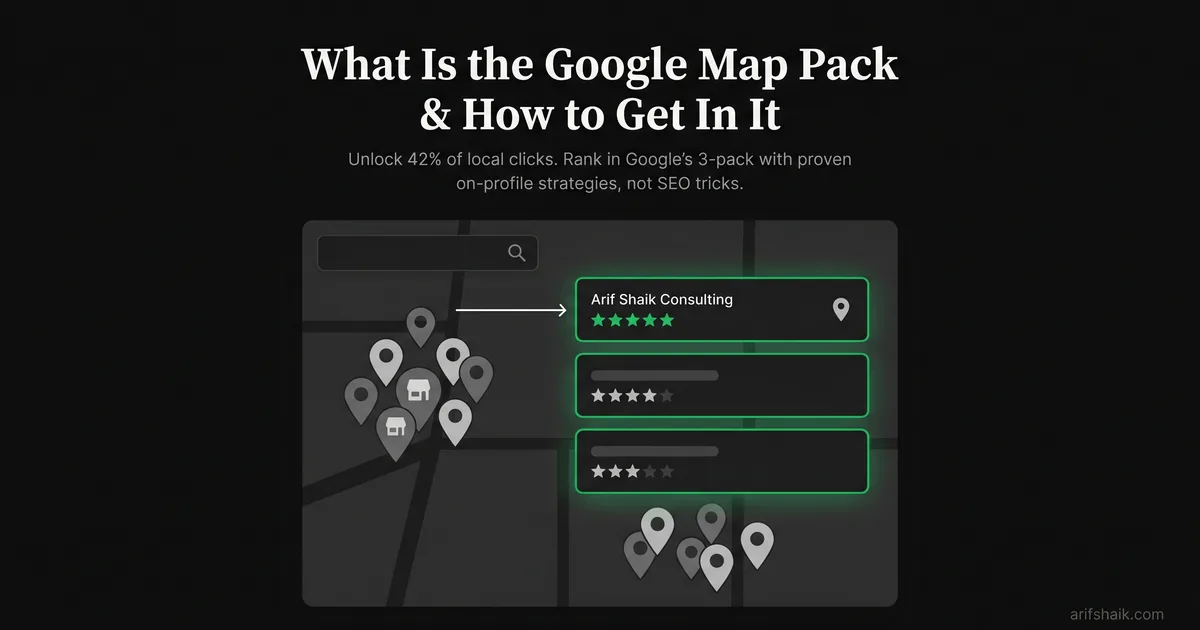
The Google Map Pack is the block of three local business listings that appears at the top of Google search results whenever someone searches with local intent. It sits above organic results, and for most local businesses, it is the single highest-value piece of real estate on the internet.
If you run a local business and you are not in the map pack for your core keywords, you are invisible to the people most ready to buy. They see three names. They pick one. That is how local search works in 2026.
I have spent five years recovering suspended Google Business Profiles and then helping those businesses climb back into the local 3-pack (for the deep-dive ranking playbook see how to rank higher on Google Maps). The pattern I see over and over: business owners chase backlinks, citations, and SEO hacks while ignoring the profile sitting right in front of them. Whitespark's 2023 and 2026 Local Search Ranking Factors surveys both put on-profile signals (primary category, reviews, business title, services) among the top-weighted inputs — primary category alone ranks as the single strongest lever. Fix the profile first, always, using the full GBP optimization checklist.
What Exactly Is the Google Map Pack?
Google calls it the "local pack." SEOs call it the "map pack," the "3-pack," or the "Google Maps local pack." Same thing. When someone types "plumber near me" or "best pizza in Austin," Google shows a map with three pinned businesses and their key details: name, rating, review count, address, hours, and phone number.
This block appears above the ten blue links. It appears above paid ads in many cases. And it appears on both desktop and mobile, though on mobile it dominates the entire first screen.
The map pack pulls its data from Google Business Profiles. Not your website. Not your social media. Your GBP. That is why on-profile optimization matters more than anything else for local rankings.
There is also a "local finder" — the expanded list you see when you click "More places" below the 3-pack. Ranking 4th or 5th in the local finder still gets some traffic, but the drop-off from position 3 to position 4 is brutal. The 3-pack is where you want to be. If your listing disappears from the 3-pack entirely, work through our business not showing on Google Maps troubleshooter before assuming it's a ranking issue.
What the map pack shows searchers
- Business name (exactly as it appears in your GBP)
- Star rating and total review count
- Business category
- Address or service area designation
- Hours of operation and "Open now" or "Closed" status
- Phone number with click-to-call on mobile
- Website link and directions button
Every one of those data points is controlled by your Google Business Profile. If any of them is wrong, incomplete, or optimized poorly, it costs you rankings and clicks.
The Three Ranking Factors Google Actually Uses
Google's local-ranking help page (Help ID 7091) names three factors for local rankings: relevance, distance, and prominence. That is not marketing speak. Those are the actual levers.
Relevance
How well does your profile match what the searcher typed? This comes down to your primary category, secondary categories, business description, services, and the content of your reviews. If someone searches "emergency locksmith" and your primary category is "locksmith" with "emergency" mentioned in your services and reviews, you match. If your primary category is "security consultant," you don't.
Distance
How close is the business to the searcher? This is the factor most SEOs hate because you cannot optimize it. A business 2 miles from the searcher beats a more optimized business 10 miles away in most cases. Period. I have seen perfectly optimized profiles lose to mediocre profiles simply because the mediocre one was closer. Proximity matters more than most SEOs will ever admit because admitting it undermines half the services they sell.
Prominence
How well-known is the business? Google measures this through review volume, review velocity, review quality, web references (citations), backlinks, and online mentions. This is where off-page SEO lives — but it is the third factor, not the first. Fix relevance signals before chasing prominence signals.
Action step: Open your Google Business Profile right now. Check your primary category. If it does not exactly match your main service, change it. This single fix moves more local rankings than any other change I have seen.
On-Profile Optimization: The Work Most People Skip
Here is the uncomfortable truth from Whitespark's 2026 Local Search Ranking Factors survey: the top-weighted inputs are all on-profile. Primary category. Business title (no keyword stuffing). Review signals. Services and attributes populated accurately. Citations, backlinks, and website SEO matter — but they are secondary to getting the profile itself correct.
Yet most local SEO agencies spend most of their effort on the secondary stuff. They build citations. They chase backlinks. They redesign websites. Meanwhile, the GBP has the wrong primary category, inconsistent NAP data, and zero posts in six months.
Categories
Your primary category is the single strongest ranking signal in local search (our Google Business Profile categories guide walks through how to choose yours). Pick the category that most precisely matches your core service. "Personal injury attorney" beats "lawyer" every time for personal injury searches. "Emergency plumber" beats "plumber" for emergency searches.
Add secondary categories for every legitimate service you offer. A dentist who also does orthodontics should have both "dentist" and "orthodontist" as categories. But do not add categories you do not actually serve. Google checks, and mismatched categories are a suspension trigger — see the dental-clinic soft suspension case study for a worked example.
Business description
Write 750 characters that describe what you do, where you do it, and what makes you different. Use natural language. Include your city and service area names. Do not stuff keywords — Google's detection is aggressive and keyword stuffing in the business title or description can flag your entire profile.
Services and products
Fill out every service you offer with descriptions and pricing where applicable. These fields feed Google's relevance algorithm directly. A plumber who lists "water heater installation," "sewer line repair," and "emergency drain cleaning" as separate services ranks for all three. A plumber who lists only "plumbing services" ranks for none specifically.
Photos
Upload service-specific photos, not stock images. Google's image recognition can tell the difference. Photos of your actual work, your team, your storefront, your equipment. Google's official Business Profile help documentation confirms that listings with photos tend to receive more direction requests and website clicks than listings without — the company does not publish a specific percent, so ignore anyone who quotes precise multipliers "from Google." Aim for 10+ photos minimum, updated monthly.
Action step: Audit your GBP services section. Add every individual service with a description of at least 50 words. This takes 30 minutes and directly expands the keywords you can rank for.
Case Study: Johnson Chimney Service — From Suspended to 3-Pack in 45 Days
Johnson Chimney Service came to me after a suspension. Their profile had been down for three weeks. When I looked at the profile before suspension, the problems were obvious: wrong primary category (they were listed as "fireplace store" instead of "chimney sweep"), business name had "Best Chimney Cleaning" appended to it, and their address was inconsistent across 20+ citation sources — the same pattern you see in our wrong-address GBP suspension breakdown.
We fixed the basics first. Corrected the business name to their legal name. Changed the primary category to "chimney sweep." Added secondary categories for "chimney cleaning service" and "fireplace repair." Cleaned up the business description. Submitted the appeal with proper documentation from our GBP reinstatement document checklist and the language from our reinstatement letter examples.
Reinstated in 9 days. But we did not stop there.
After reinstatement, I had them upload 40 service-specific photos — actual chimney jobs, before/after cleaning shots, their truck, their team. We fixed NAP consistency across all 20 citation sources. Added detailed service descriptions for every service they offered. Started weekly Google Business Profile posts with project photos — see our how often to post on GBP guidance for cadence.
45 days from reinstatement, they were in the 3-pack for "chimney sweep" and "chimney cleaning" — their two core keywords. They had never ranked in the 3-pack before the suspension. The suspension forced them to fix everything that had been holding them back.
Here is what I learned from this case: the profile was never optimized to begin with. The suspension was actually the catalyst that made them take the profile seriously. Every fix we made was an on-profile fix. We did not build a single backlink. We did not do any website SEO. We fixed the profile and let Google's algorithm do the rest.
Action step: Compare your GBP business name against your legal name on your business license. If there is anything extra — location names, service keywords, slogans — remove it now before Google does it for you.
NAP Consistency: The Silent Killer
NAP stands for Name, Address, Phone number. If your NAP is inconsistent across the internet — different phone number on Yelp, old address on Yellow Pages, slightly different business name on the BBB — Google loses confidence in your listing. Reduced confidence means reduced rankings.
I am not talking about minor formatting differences. "Street" versus "St." is fine. I am talking about different phone numbers, different suite numbers, old addresses from before you moved, or business name variations that include or exclude "LLC" or "Inc." inconsistently.
The fix is tedious but straightforward. Search your business name on Google. Check every directory listing that appears on the first three pages. Update every one to match your GBP exactly. Focus on the big ones first: Yelp, Facebook, Apple Maps, Bing Places, Yellow Pages, BBB, and any industry-specific directories.
For Johnson Chimney Service, we found their old phone number on 8 directories, their previous address on 4, and a name variation on 6. Cleaning those up took a week of manual work but was a direct contributor to their 3-pack ranking.
Action step: Google your business name plus your city. Open every result on the first three pages. Write down every NAP inconsistency. Fix them all within the next two weeks. Start with Yelp, Facebook, and Apple Maps.
Reviews: Quality Over Quantity (But Quantity Still Matters)
Reviews are the strongest prominence signal for map pack rankings. But the game is not "get as many reviews as possible as fast as possible." Google watches velocity. A business that goes from 10 reviews to 60 reviews in a month looks suspicious. A business that gains 2-3 reviews per week consistently looks healthy.
What matters for rankings:
- Total review count (higher is better, but velocity matters more than total)
- Average star rating (aim for 4.5+ — Joy Hawkins at Sterling Sky has tested this and found Google does not hard-suppress below a specific star threshold, but lower-rated listings lose conversions even when they do rank)
- Review recency (reviews from the last 90 days weigh more than older ones)
- Review content (reviews that mention specific services help you rank for those services)
- Owner responses (responding to every review signals an active, engaged business)
Do not buy reviews. Do not incentivize reviews. Do not use review gating (filtering unhappy customers out before they review). All of these violate Google's policies and can get your profile suspended — see the exact teardown in our GBP suspended for fake reviews guide. I have handled dozens of suspensions caused by review manipulation. The recovery is painful and the review loss is often permanent (our Google reviews deleted explainer covers how to diagnose the deletions).
Action step: Set up a simple review request process using our how to get more Google reviews playbook. After every completed job, send a text or email with a direct link to your Google review page. Aim for 2-3 new reviews per week. Respond to every single review within 24 hours — positive and negative — with the language examples in how to respond to Google reviews.
The Proximity Problem: What You Cannot Optimize
Here is where I need to be honest with you, even though it is not what you want to hear.
Proximity — the distance between your business and the person searching — is the hardest factor to overcome. If your competitor is 1 mile from a cluster of searchers and you are 5 miles away, they have a structural advantage that no amount of optimization fully overcomes.
I have watched businesses do everything right — perfect categories, 200+ reviews, weekly posts, clean NAP, strong backlinks — and still lose the 3-pack to a competitor with 30 reviews and a bare-bones profile. Because the competitor was closer.
This does not mean optimization is pointless. It means optimization determines who wins among businesses that are roughly equidistant from the searcher. If there are three plumbers within 3 miles of downtown and you are one of them, optimization decides whether you get slot 1, 2, or 3 in the pack. But if you are the only one 10 miles away, optimization alone will not close that gap.
For service-area businesses that do not have a storefront, the picture is different. Google uses your stated service area to determine relevance, and optimization carries more weight because there is no fixed pin on the map. If you run a service-area business, on-profile optimization is even more critical — and the SAB setup has unique suspension risks covered in service area business suspended: what to do.
Action step: Use Google Maps to search your core keyword from different locations in your service area. Note where you appear and where you do not. Focus your marketing in the zones where you are already close to the 3-pack (positions 4-7) because those are the areas where optimization can push you over the edge.
Off-Page Signals: What Matters After the Profile Is Right
Citations, backlinks, website SEO, and behavioral signals are real ranking inputs — Whitespark's 2026 LSRF confirms that — but they rank below on-profile factors in weight. Get the profile right first, then layer these on:
- Citations: Consistent listings across directories. Focus on the top 30-40 directories, not 500+ low-quality ones.
- Backlinks: Links to your website from local sources — local news, chamber of commerce, local blogs, industry associations. Quality over quantity.
- Website SEO: Your website should have city-specific pages, schema markup for local business, and fast load times. But website SEO supports map pack rankings — it does not drive them.
- Behavioral signals: Click-through rate from search results, calls from the listing, direction requests. These are outcomes of good optimization, not inputs you can directly control.
My biggest mistake early in my career was telling clients to chase backlinks and citations before fixing their GBP. I watched businesses spend thousands on link building while their primary category was wrong and their service list was empty. Those citations did nothing because the profile was not optimized to convert the ranking signals into actual rankings.
Action step: If you have not completed the on-profile optimizations above, stop here. Do those first. Only move to off-page work after your categories, services, photos, reviews, and NAP are fully optimized.
Common Map Pack Mistakes I See Every Week
After five years of GBP recovery work, these are the mistakes that cost businesses their map pack position most often:
- Wrong primary category. This is number one. A "general contractor" trying to rank for "kitchen remodeling" will lose to a "kitchen remodeler" every time. Be specific.
- Keyword-stuffed business name. "Mike's Plumbing - Best Plumber in Dallas TX 24/7 Emergency" will get you suspended. Use your legal name only.
- No services listed. If Google does not know what you offer, Google cannot match you to searches for those services.
- Stock photos or no photos. Google's image AI is real. Stock photos do not help. No photos actively hurt.
- Review drought. No new reviews in 90+ days tells Google the business might be inactive. Even 1 review per week keeps the signal alive.
- Inconsistent hours. If your GBP says 9-5 but your website says 8-6, Google flags the inconsistency and reduces confidence — editing hours carelessly is also a common path to suspensions triggered by profile edits.
- Chasing off-page before on-page. I have said it three times in this article because I see it three times a week. Fix the profile first.
Action step: Run through this list right now. If any of these apply to your profile, fix them today. Each one is a 5-15 minute fix that directly impacts your map pack eligibility.
Your Map Pack Action Plan (This Week)
Here is what I would do if I were starting from zero, in order of priority:
- Day 1: Audit and correct your primary category. Add all relevant secondary categories. Fix your business name to match your legal name exactly.
- Day 2: Write out every service you offer as a separate service entry with a 50+ word description for each.
- Day 3: Upload 20+ real photos of your work, team, location, and equipment. Remove any stock photos.
- Day 4: Google your business name and fix NAP inconsistencies on the first 10 directories you find.
- Day 5: Set up a review request workflow. Send your first batch of requests to your 10 most recent happy customers.
- Ongoing: Post once per week with a project photo or offer. Respond to every review within 24 hours. Add 2-3 new photos per month.
This is not complicated. It is tedious. But every item on this list is something you control, something you can do this week, and something that directly impacts whether you show up in the 3-pack or disappear into the local finder where nobody looks.
Frequently Asked Questions
How long does it take to get into the Google Map Pack?
Can a service-area business rank in the map pack?
Does my website affect map pack rankings?
How many reviews do I need to rank in the 3-pack?
Related Articles
Get notified when I publish new recovery guides
Struggling with a suspended GBP profile?
I’ve recovered 500+ profiles across 60+ countries. Let me look at yours for free — most assessments take under 24 hours.

Google Business Profile Recovery Specialist
Independent Google Business Profile recovery consultant specializing in suspensions, soft suspensions, and reinstatement appeals. Since 2019, recovered 500+ GBP profiles across 60+ countries — from solo tradespeople to multi-location law firms and healthcare groups. Former Upwork Top Rated freelancer (200+ completed contracts, 5-star average) now consulting direct. Research informed by Sterling Sky (Joy Hawkins), Local Search Forum, and daily work inside Google's Business Profile Community. Every case study and recovery playbook on this site is drawn from real client work — no theory, no AI-generated filler.