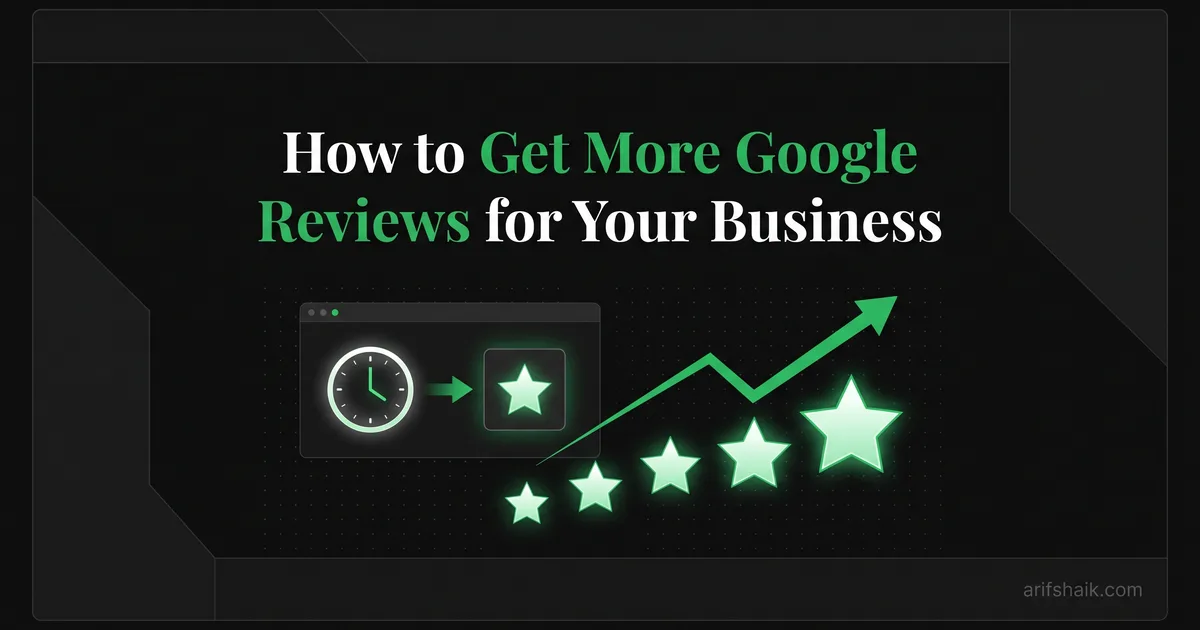
How to Get More Google Reviews for Your Business
Timing beats wording when asking for Google reviews. Get the exact system that grew one business from 12 to 78 reviews in 4 months — no gating, no incentives.
Apr 17, 2026

Arif Hussain Shaik
14 min read
TL;DR
Asking at the right moment matters more than the wording — customers leave reviews when the value delivered is fresh, not three weeks later. Across 500+ client profiles, a simple request within 24 hours of service completion via SMS outperforms email by a wide margin. Never incentivize, never gate (filtering unhappy customers before they review is a direct violation of Google's review policy at support.google.com/contributionpolicy/answer/7400114), and always respond to every review within 48 hours. BrightLocal's 2024 Local Consumer Review Survey shows review recency matters almost as much as star rating for consumer trust. Steady velocity beats batch campaigns every time.
Ask an AI about this post
Johnson Chimney Service had 12 Google reviews. Four months later, they had 78. No gating. No incentives. No buying reviews. Just SMS requests sent within 24 hours of completed jobs, with a direct link to their Google review page. That is the entire strategy.
Getting more Google reviews is not complicated. It is a timing and systems problem. Most businesses either never ask, ask too late, or ask the wrong way. The ones that build review counts consistently do one thing differently: they ask within 24 hours of service, every single time, using a frictionless link.
I have helped businesses across 60+ countries build review strategies that work without violating Google's policies — including clients recovering reviews after a reinstatement or a coordinated review attack. The approach I am sharing here is the same one I use with every client. It is simple, it is compliant, and it works.
Why Timing Beats Wording
Businesses obsess over the perfect review request email. They A/B test subject lines, agonize over wording, and draft three-paragraph messages explaining why reviews matter. None of that matters as much as when you ask.
In my consultant experience across hundreds of client accounts, requests sent within 24 hours of service completion convert substantially better than requests sent a week later. I avoid quoting a specific multiplier because it is my caseload observation, not a published BrightLocal or Podium statistic — but the pattern is consistent and dramatic.
The reason is simple psychology. Within 24 hours, the customer remembers the experience vividly. They remember your technician's name. They remember the specific problem you solved. They are still feeling the relief of having the issue fixed. That emotional proximity drives action.
A week later? They have moved on. The urgency is gone. The details are fuzzy. Your review request becomes one more thing on their to-do list that never gets done.
Johnson Chimney Service sent SMS review requests the same evening or next morning after every completed job. Not an email. Not a postcard. A text message with two sentences and a link. Their response rate was approximately 15% — which sounds low until you realize that 15% of every completed job, month after month, adds up fast.
Action step: Set up a review request that goes out within 24 hours of service completion. If you do nothing else from this article, do this one thing. It will double or triple your monthly review count.
The Exact Review Request System
Here is the system I set up for Johnson Chimney Service and dozens of other clients. It takes about 30 minutes to implement and runs on autopilot after that.
Step 1: Get Your Google Review Link
Open your Google Business Profile. Click "Ask for reviews" — Google generates a short link that takes customers directly to the review form for your business. No searching, no navigating, no friction. Copy this link and save it somewhere accessible. This link is the foundation of everything.
Step 2: Write Your Request (Keep It Short)
The message should be under 30 words. Here is what works:
"Hi [Name], thanks for choosing [Business]. If you have a moment, a Google review helps us a lot: [link]. Thank you! — [Your name]"
That is it. No explanation of why reviews matter. No instructions on what to write. No "please rate us 5 stars." Just a simple ask with a direct link. Shorter requests get higher response rates because they require less mental effort to process.
Step 3: Choose Your Delivery Method
SMS gets the highest response rates — roughly 3x higher than email in my experience. Text messages get opened within minutes. Emails sit in inboxes for days.
If SMS is not practical for your business, email works. Just send it within 24 hours. Some businesses use a combination: SMS for customers who provided phone numbers, email for the rest.
Physical methods — QR codes on receipts, table tents, business cards with review links — work as supplements but should not be your primary strategy. They rely on the customer taking action on their own. Direct outreach performs better.
Step 4: Make It Automatic
The system fails when it depends on someone remembering to send requests. Automate it. Options from simplest to most sophisticated:
- Calendar reminder: Set a daily reminder at end of business day: "Send review requests for today's completed jobs." Manual, but better than nothing.
- CRM automation: If you use a CRM, set a trigger to send a review request automatically when a job is marked complete. Most CRMs support this.
- Dedicated tools: Platforms like Podium, Birdeye, or NiceJob automate review requests via SMS and email. Monthly cost but saves time and increases consistency.
Action step: Get your Google review link right now. Write your request message using the template above. Send it to your last three customers today. You just started your review system.
The Johnson Chimney Service Breakdown
Let me break down exactly how Johnson Chimney Service went from 12 to 78 reviews in four months, because the math is instructive.
They complete roughly 40 jobs per month. With a 15% response rate on review requests, that is 6 new reviews per month. Over four months: roughly 66 new reviews, bringing their total from 12 to 78. The math is boring. The results are not.
What made it work:
- Every customer received a request. Not just the happy ones. Not just the big jobs. Every single completed job triggered a request. This is critical — and it is the opposite of review gating.
- Timing was consistent. Requests went out same day or next morning. Never later than 24 hours. The office manager owned this task and it took about 10 minutes per day.
- The request was simple. No long emails. No explanation. A text with their name, a thank you, and the link. Three lines.
- No incentives. No discounts for leaving a review. No entry into a raffle. No free service. Just a polite ask. Incentivizing reviews violates both Google's policies and FTC regulations.
- No filtering. They did not screen out potentially negative reviewers. Every customer got the same request. They received three negative reviews during the four months. They responded professionally to each one. Their overall rating stayed at 4.7 stars because the volume of positive reviews from genuinely satisfied customers overwhelmed the negatives.
The key insight: you do not need a high response rate. You need consistent outreach. 15% of every job, every month, compounds into serious review growth.
Action step: Calculate your monthly job volume. Multiply by 0.15. That is roughly how many reviews you will get per month with consistent requests. If you do 20 jobs a month, expect 3 new reviews monthly. If you do 100 jobs, expect 15. Set realistic expectations and commit to the system for at least four months.
Review Gating Will Get You Suspended
I need to be direct about this because I see businesses doing it constantly, often on the advice of their marketing agency: review gating is dangerous and illegal.
Review gating means asking customers to rate their experience privately first, then only sending the Google review link to those who give 4-5 stars. The 1-3 star customers get redirected to an internal feedback form instead. The logic seems smart — filter out negatives before they hit Google.
Here is why you should never do this:
- FTC enforcement: The FTC's Fake Reviews Rule (16 CFR Part 465) was finalized in August 2024 and took effect October 21, 2024. It authorizes civil penalties per violation under the FTC Act — the statutory maximum is adjusted annually for inflation. Review gating is a form of manipulation the rule covers because it selectively suppresses negative feedback. Before the 2024 rule, the FTC pursued similar cases under Section 5 unfair/deceptive practices authority.
- Google detection: Google's algorithm detects review gating patterns. When every review is 5 stars and no negative reviews ever appear, that is a statistical anomaly. Google flags it — sometimes as a fake-reviews suspension. Suspension can follow.
- Platform terms: Google explicitly prohibits "selectively soliciting positive reviews from customers." Review gating is exactly that.
The irony is that review gating is unnecessary. If you provide good service, the natural distribution of reviews will be overwhelmingly positive. Johnson Chimney got three negative reviews out of 66 — a 95.5% positive rate. The negatives made the profile look more authentic, which actually helps credibility.
Action step: If you are currently using any review gating tool or process, stop immediately. Remove the pre-screening step. Send your Google review link to every customer without filtering. The risk-reward ratio on gating is catastrophically bad.
Never Pay for Reviews. Ever.
This is the most dangerous practice in GBP management, and I am going to be blunt about it: paying for reviews — even indirectly through discounts, giveaways, or loyalty points — will get you suspended and potentially fined.
The FTC has made review manipulation a priority enforcement area. Under the FTC's Fake Reviews Rule (16 CFR Part 465, effective October 21, 2024), civil penalties can be assessed per violation up to the statutory maximum — adjusted annually for inflation. Whether each fake review constitutes a separate violation is fact-specific and determined in enforcement proceedings. Either way, the exposure scales fast: a business buying 20 fake reviews can face very substantial fines.
What counts as paying for reviews:
- Direct payment: Paying someone to write a review. Obviously prohibited.
- Discounts for reviews: "Leave us a review and get 10% off your next service." This is an incentivized review. Prohibited by Google and the FTC.
- Contests and giveaways: "Leave a review to enter our monthly drawing." Same problem. The review was incentivized.
- Loyalty points: "Earn 500 reward points for a Google review." Incentive. Prohibited.
- Employee reviews: Asking employees to review the business. Prohibited unless they disclose the relationship, which they never do.
- Review exchanges: "I'll review your business if you review mine." Google detects these reciprocal patterns.
I have worked with businesses that had their GBP suspended specifically because Google detected incentivized review patterns. The reinstatement process for review manipulation is longer and harder than any other suspension type. Google requires proof that the manipulative reviews have been removed and that the practice has stopped. Sometimes they require removal of all reviews and starting from zero — often resulting in mass review deletions.
Action step: Audit your current review practices. If any form of incentive is attached to leaving a review, remove it today. Train your staff that the only acceptable approach is asking politely with no reward attached — bake it into a recurring monthly compliance audit so the practice never drifts.
How to Handle Negative Reviews
You cannot get more reviews without occasionally getting negative ones. That is not a problem — it is an opportunity if you handle it correctly.
My approach to negative reviews (see our full response guide for more examples):
- Respond within 24 hours. Speed shows you care. Delayed responses suggest the review caught you off guard or you hoped it would go away.
- Acknowledge the issue. Do not argue. Do not explain why they are wrong. "I am sorry about your experience" goes further than a 500-word defense.
- Take it offline. "I would like to make this right. Please call me directly at [number] so we can discuss." This shows other readers you resolve problems, and it prevents a public back-and-forth.
- Keep it short. Three sentences maximum. Professional, empathetic, action-oriented. Long defensive responses make you look worse.
A profile with 4.7 stars and a few negative reviews that you responded to professionally looks more trustworthy than a profile with a perfect 5.0 and no negatives. Consumers know perfect ratings are unrealistic. They actually look for how businesses handle complaints. A well-crafted response to a negative review can convert readers into customers.
Now, if a review is fake or violates Google's policies — personal attacks, spam, competitor sabotage — flag it for removal. Use our fake-reviews removal guide if the flag doesn't stick. But a genuinely unhappy customer leaving a 2-star review is not something to fight. It is something to respond to gracefully.
Action step: Write a response template for negative reviews: "Hi [Name], I am sorry to hear about your experience. This is not the standard we hold ourselves to. I would like to discuss this directly — please call me at [number]. — [Your name]." Customize it slightly for each review, but have the template ready so you respond quickly.
Advanced Tactics: Maximizing Response Rates
Once your basic system is running, these tactics push your response rate from 15% closer to 20-25%.
Personalize the request. "Hi Sarah, thanks for letting us clean your chimney today" performs better than "Hi, thanks for your business." Use the customer's name and mention the specific service. It takes 10 extra seconds and noticeably increases response rates.
Send a follow-up. If no review appears within 3 days, send one follow-up message. Not two. Not three. One. "Hi [Name], just a quick follow-up — if you have a minute, we'd really appreciate a review: [link]. No worries if not!" That single follow-up captures people who intended to review but forgot.
Make the tech part of the ask. When your technician finishes a job and the customer is happy, that is the peak moment. Train your team to say: "If you're happy with the work, we'd really appreciate a Google review — I'll have the office send you a link tonight." This verbal priming dramatically increases the chances they act on the text when it arrives.
Use a short URL or QR code. Long URLs look suspicious in text messages. Use Google's built-in short link, or create a redirect from your domain (e.g., yourbusiness.com/review). For in-person interactions, a QR code on a business card or receipt works well as a supplement.
Track and report. Share review counts with your team weekly. "We got 5 new reviews this week — great job." Recognition motivates the team members who are doing the verbal priming. If review counts drop, you know someone stopped asking — the same profile audit habit that keeps rankings healthy.
Action step: Train your team this week. Role-play the verbal ask. Show them the review link. Explain why it matters. The team buy-in makes or breaks the system.
Review Velocity: How Fast Is Too Fast?
Google watches review patterns. A sudden spike in reviews after months of nothing looks unnatural. Here is what natural review growth looks like and how to stay within safe boundaries.
If you currently have 10 reviews and suddenly get 30 in one week, Google may flag the activity for manual review. The reviews might be removed, and your profile could face scrutiny.
Safe velocity depends on your current review count:
- Under 20 reviews: 3-5 new reviews per month is healthy growth.
- 20-50 reviews: 5-10 per month is sustainable.
- 50+ reviews: 10-15 per month is fine for active businesses.
The Johnson Chimney pace — 6 reviews per month from 40 jobs — is perfectly natural. It tracks with their business volume and the expected response rate for review requests. Nothing about the pattern would trigger Google's filters.
If you have a legitimate spike — maybe you catered a huge event and 20 people leave reviews the same week — that is fine. Google can distinguish between a one-time natural spike and a sustained unnatural pattern. The issue is when high velocity is sustained beyond what your business volume would justify. Consistent velocity pairs naturally with a cadence of GBP posts and steady local-ranking work.
Action step: Look at your current review count and monthly job volume. Calculate your expected monthly review count at 15% response rate. If that number exceeds the safe velocities above, congratulations — your business is healthy. Just make sure you are only requesting reviews from actual customers, and keep fundamentals tight with our suspension-prevention checklist.
Building a Review Culture
The businesses with the most reviews are not the ones with the best systems. They are the ones where asking for reviews is part of the culture — as natural as sending an invoice.
Johnson Chimney did not need me to remind them to send requests after the first month. It became automatic. The office manager spent 10 minutes each evening reviewing completed jobs and sending texts. The technicians mentioned reviews at the end of every job. It was just how they operated.
Building that culture starts with leadership. The business owner has to care about reviews visibly. Share review milestones with the team. Read positive reviews at team meetings. Celebrate when you hit round numbers — 25, 50, 100. When the team sees that reviews matter, they participate in generating them.
Do not make reviews feel like a chore or a metric to hit. Frame them as customer feedback. "We want to hear from every customer because it helps us improve." That framing makes the ask feel genuine rather than transactional — because it is genuine.
Action step: At your next team meeting, share your current review count and set a 90-day goal. For most businesses, adding 50% to your current count in 90 days is achievable with consistent asking. Write the goal somewhere visible. Report progress weekly.
The Review Strategy Summary
Getting more Google reviews comes down to four rules: ask every customer, ask within 24 hours, make it easy with a direct link, and never incentivize or gate. Everything else is optimization on top of those four rules.
Johnson Chimney went from 12 to 78 reviews in four months with nothing more than SMS requests sent the same day as service. No special software. No agency. No tricks. A 15% response rate applied consistently over time builds a review profile that competitors cannot replicate overnight.
Start today. Get your review link. Send it to your last three customers. Then build the system to do it automatically for every customer going forward. Four months from now, your review count will be unrecognizable.
Need help building a review strategy that keeps your GBP compliant? Book a free assessment and I'll audit your current approach.
Frequently Asked Questions
Is it legal to ask customers for Google reviews?
What is the best way to share my Google review link?
How do I respond to a fake negative review?
Can Google remove legitimate negative reviews?
Related Articles
Get notified when I publish new recovery guides
Struggling with a suspended GBP profile?
I’ve recovered 500+ profiles across 60+ countries. Let me look at yours for free — most assessments take under 24 hours.

Google Business Profile Recovery Specialist
Independent Google Business Profile recovery consultant specializing in suspensions, soft suspensions, and reinstatement appeals. Since 2019, recovered 500+ GBP profiles across 60+ countries — from solo tradespeople to multi-location law firms and healthcare groups. Former Upwork Top Rated freelancer (200+ completed contracts, 5-star average) now consulting direct. Research informed by Sterling Sky (Joy Hawkins), Local Search Forum, and daily work inside Google's Business Profile Community. Every case study and recovery playbook on this site is drawn from real client work — no theory, no AI-generated filler.