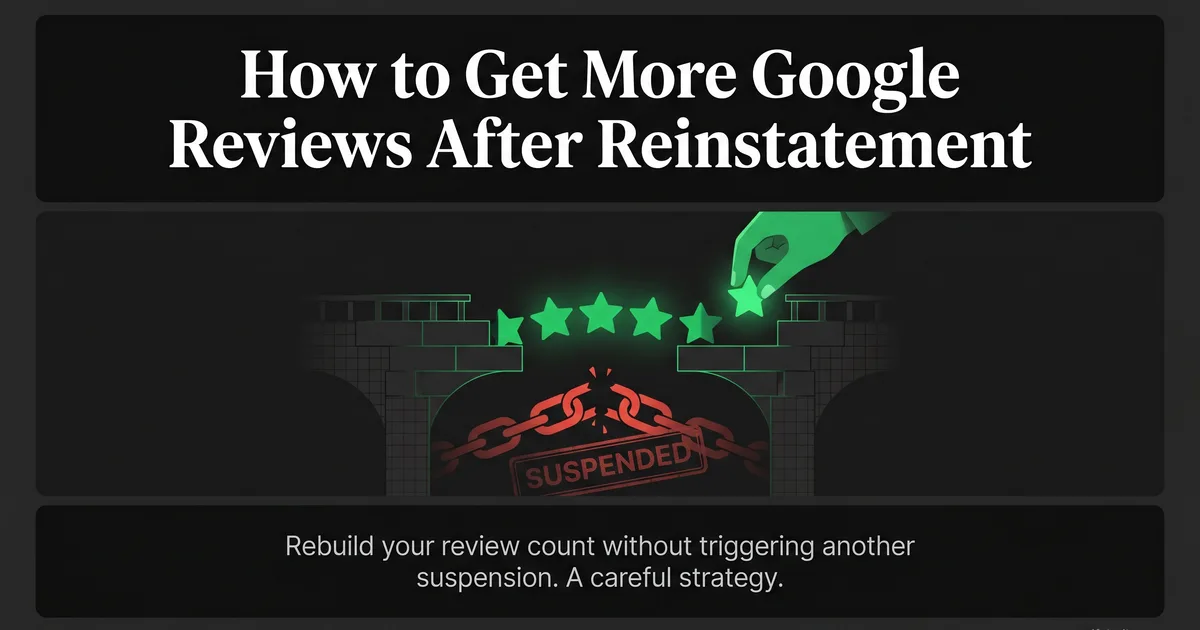
How to Get More Google Reviews After Reinstatement
Recover your Google review count after GBP reinstatement with a careful, policy-compliant strategy — rebuild reviews without triggering another suspension.
Apr 8, 2026 · Updated Apr 23, 2026

Arif Hussain Shaik
6 min read
TL;DR
Rebuilding reviews after reinstatement is a 3-6 month job, not a sprint. Return to your previous review pace — don't try to replace lost reviews in weeks. Incentives, review gating, and mass-email campaigns re-suspend more profiles than anything else post-reinstatement. In-person asks, single post-service follow-up messages, and point-of-sale QR codes are the only safe channels.
Ask an AI about this post
Your Review Count After Reinstatement: What to Expect
Getting reinstated is a win — but it's often followed by a second problem. Profiles that were suspended sometimes come back with fewer reviews than they had before. Some reviews are removed during the suspension period. Some were already removed by Google before the suspension as part of a review quality enforcement action. And in some cases, the review count comes back exactly as it was.
Whatever state your review count is in after reinstatement, rebuilding it correctly is critical. The wrong approach — asking too many customers at once, offering incentives, or using review gating — risks triggering another suspension from the same review manipulation signals that may have caused the first one. The right approach is methodical, policy-compliant, and genuinely effective — see our full playbook for earning Google reviews.
For the full context on what happened to your reviews and whether they can be recovered, see the Google removed my reviews after reinstatement guide. This guide picks up from there — focusing on building new reviews correctly going forward.
Why Review Velocity Matters More Than Count
The biggest mistake businesses make after reinstatement is trying to recover their review count too quickly. I understand the impulse — you had 47 reviews, you're back to 23, and you want to close that gap immediately. But rushing it is exactly what re-triggers the manipulation flags that caused the original problem.
Google's review systems monitor velocity (reviews per time period) as closely as they monitor total count. A business that averages 2-3 reviews per month suddenly receiving 15 in a week looks like manipulation — even if every review is completely genuine and from a real customer. The algorithm doesn't know the difference between a legitimate post-reinstatement recovery campaign and a review-bombing operation or a purchased review service.
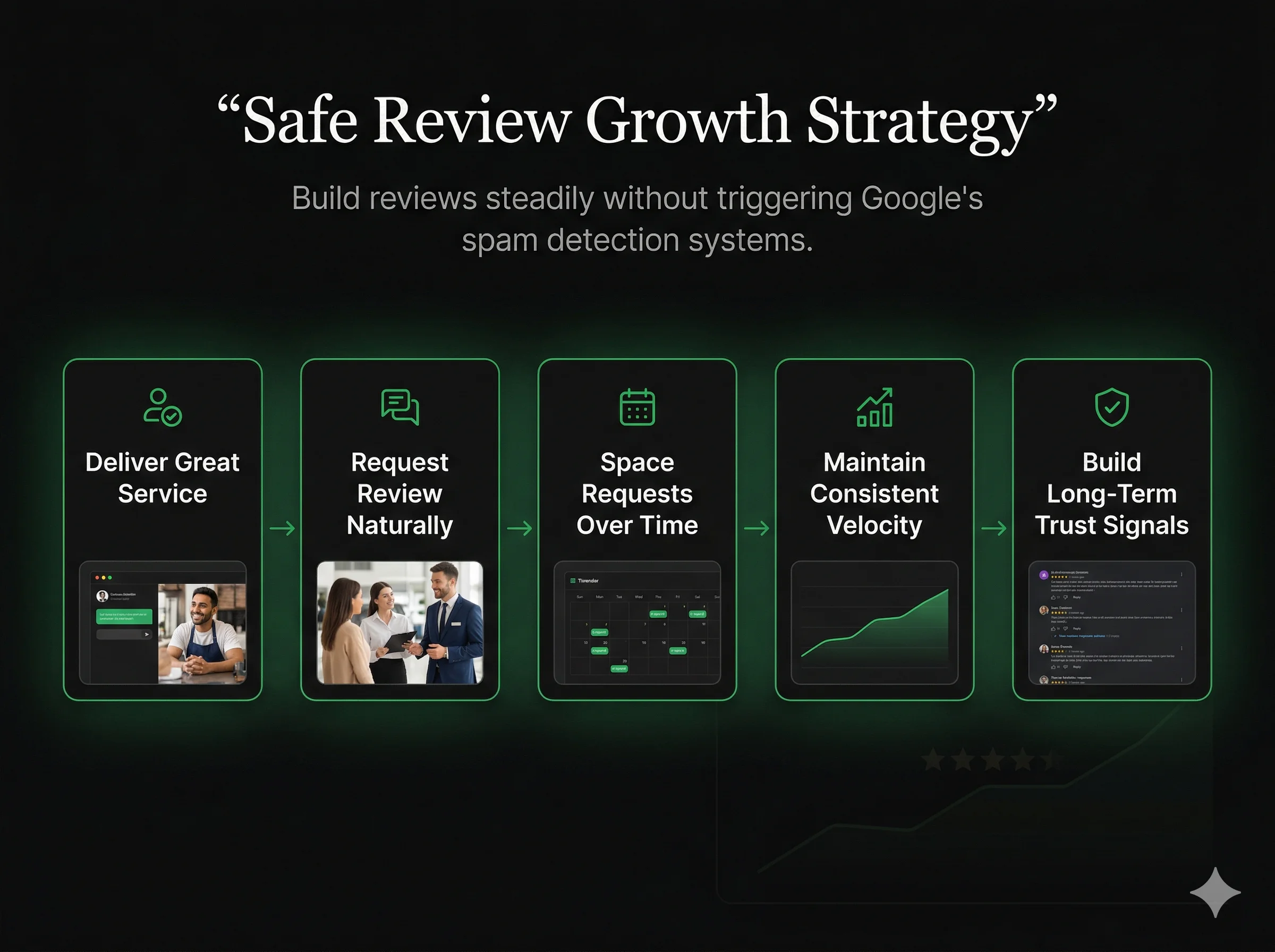
Set a realistic target: aim to return to your previous review pace, not to replace lost reviews in a sprint. If you used to receive 3-4 reviews per month, build back to that pace. After 60-90 days of consistent, organic review growth, your account history will show a healthy pattern and the heightened scrutiny that follows reinstatement will ease — pair this with our suspension prevention checklist.
The Three Legitimate Review Request Methods
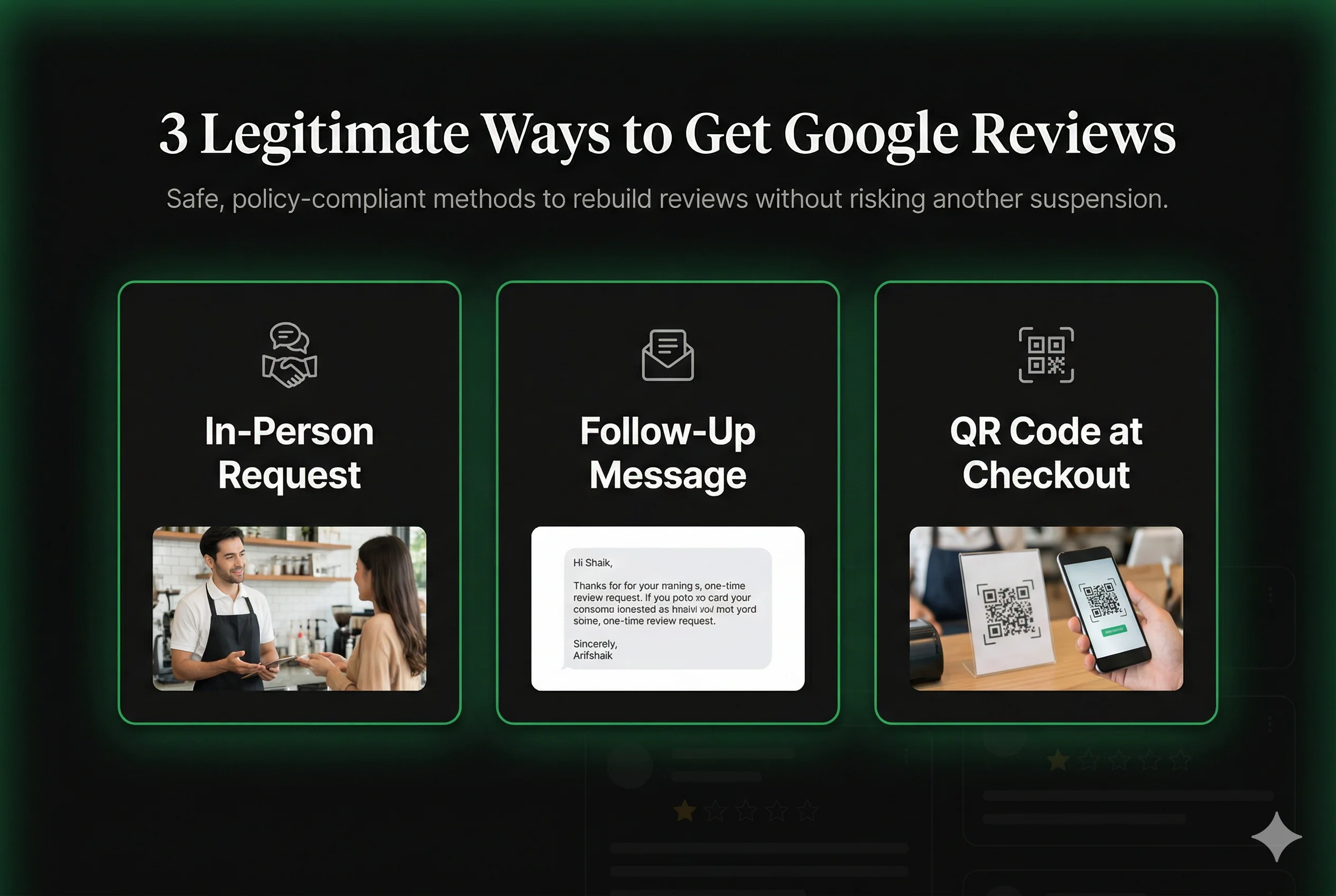
1. In-Person Verbal Request
The most natural and highest-converting method. At the end of a service or appointment, simply say: "We'd really appreciate it if you had a moment to leave us a Google review — it helps us a lot." That's it. No QR code required, no follow-up email — just a genuine ask from a person who just served them.
The key is asking after you've delivered a good experience — not routinely at checkout regardless of how the interaction went. A customer who just had an exceptional experience is far more likely to leave a review than one who had an average one, and the resulting review will be more substantive.
2. Post-Service Follow-Up Message
Sending a single follow-up text or email 24-48 hours after service completion is effective and policy-compliant. The message should be simple, personal, and without pressure: "Hi [Name], thank you for choosing [Business Name]. If you have a moment, we'd love to hear your feedback on Google." Include your direct Google review link.
Send one message per customer. Do not send reminders if they don't respond — follow-up messages to non-responders feel pushy and occasionally prompt retaliatory negative reviews. One genuine ask is enough.
Critical: do not send this to your entire customer database at once. After reinstatement, any sudden volume spike in review requests will generate a corresponding spike in reviews, which flags the manipulation detection system. Space out your requests to match your service delivery rate.
3. QR Code at Point of Sale
A QR code displayed at your checkout counter, on your receipt, or on your business card is a passive, always-on review request. Customers who had a great experience and want to leave a review can do so immediately without needing a separate message. This generates a slow, steady, organic review flow — exactly the pattern that looks healthy to Google's systems. Pair it with regular GBP posts and a consistent posting cadence for the best signal.
Generate a review QR code from your GBP dashboard (Get More Reviews → Share review form) and print it on card stock or a small countertop sign. Update it if your GBP link changes.
What Not to Do After Reinstatement
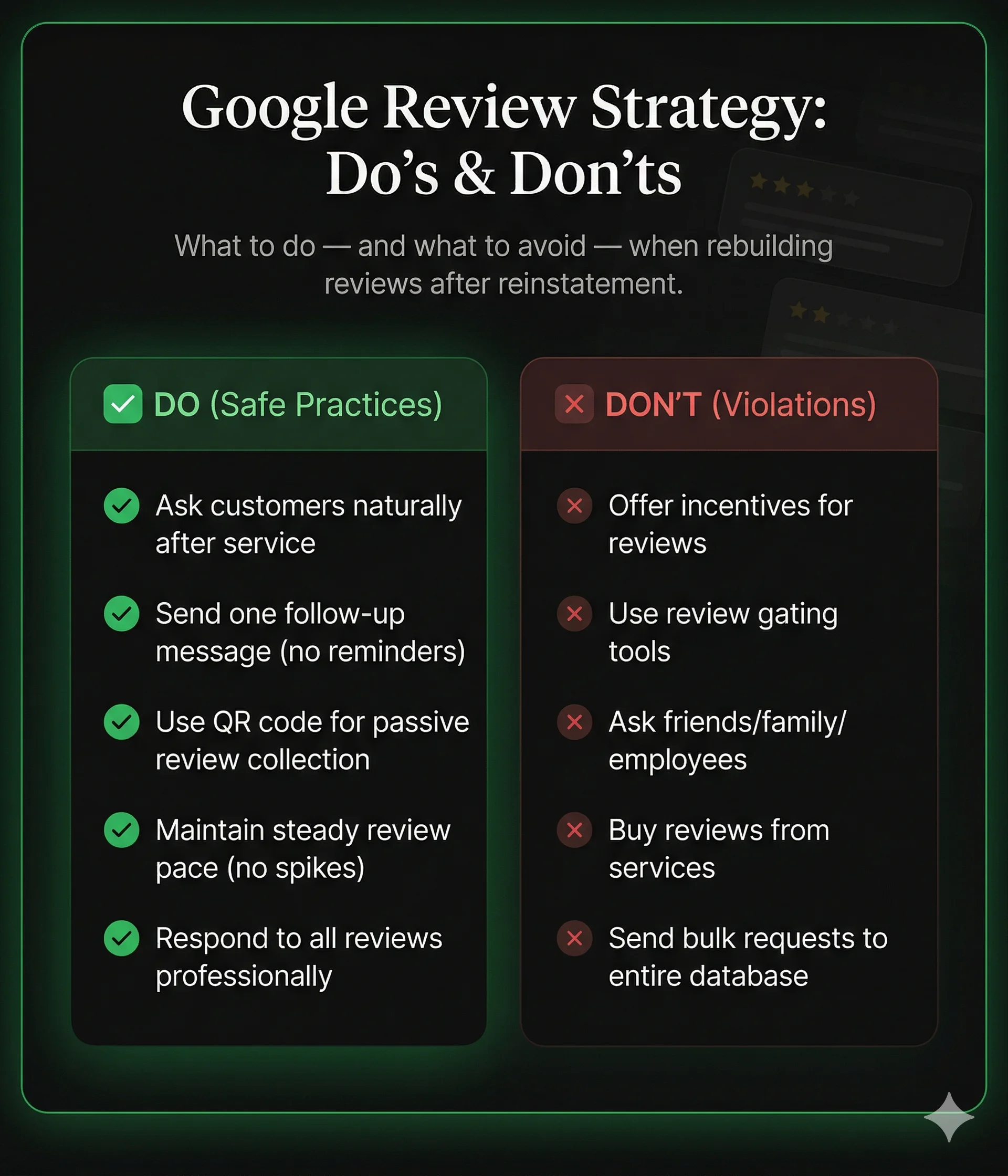
- Do not offer incentives for reviews. Discounts, free items, loyalty points, or any tangible benefit in exchange for a review is a policy violation per Google's incentivized contributions policy. Even "leave us a review and get 10% off your next visit" qualifies. This is the single most common mistake I see post-reinstatement.
- Do not use review gating software. Review gating tools ask customers to rate their experience first — if they select positive, they're directed to Google; if they select negative, they're directed to internal feedback. This practice is explicitly prohibited by Google's policies.
- Do not ask friends, family, or employees for reviews. Even if they're genuine fans of your business, reviews from people with a personal or professional relationship to the business owner are a quality violation.
- Do not purchase reviews from any service. Purchased review services use fake accounts, proxies, and content farms. Google detects these reliably — report them through our report-fake-reviews guide if competitors are doing it to you. Post-reinstatement, your profile is under heightened scrutiny — purchased reviews are almost certain to trigger re-suspension.
- Do not mass-email your entire customer database. Even a compliant, incentive-free email sent to 500 customers simultaneously will generate a review spike that looks like a manipulation campaign.
Responding to Reviews: A Strategy for Trust Signals
Responding to reviews is not just good customer service — it's a compliance signal. An actively managed profile with regular, professional responses is far less likely to be suspended than a neglected one with no owner activity. Here's how to respond correctly:
- Respond to all reviews within 48-72 hours. Speed signals active management.
- Keep positive responses brief and genuine. "Thank you so much, [Name] — we really appreciate it!" is better than a 3-paragraph marketing copy response that repeats your business name, city, and services six times.
- Respond to negative reviews factually and without defensiveness. Acknowledge the concern, offer to resolve it offline, and keep the tone professional. Never include your business keywords or location tags in negative review responses — this looks like spam.
- Do not include your website URL in review responses. This is considered promotional content and can be flagged.
Setting Realistic Timeline Expectations
In my consultant caseload, rebuilding review count after reinstatement is typically a 3-6 month process when done correctly. Businesses that average 2-3 new reviews per month will recover a 20-review gap in roughly 6-10 months at that pace. That's a long time — but BrightLocal's 2024 Local Consumer Review Survey consistently shows steady, organic review cadence correlates with trust signals, and Google's review policy (support.google.com/contributionspolicy/answer/7400114) penalizes anything that looks like a spike. Run a monthly compliance audit during this rebuild to catch drift early.
The alternative — trying to close the gap in weeks through aggressive review campaigns — has a high chance of re-suspension, which resets the clock entirely and makes future reinstatements harder. Slow and steady wins this race. Use the rebuild window to re-sharpen fundamentals with our GBP optimization checklist and Maps ranking playbook — steady review growth plus clean on-profile fundamentals is how you recover lost map-pack position.
Frequently Asked Questions
My reviews disappeared after reinstatement. Can I ask customers to repost them?
How many review requests can I safely send per week after reinstatement?
Should I prioritize getting reviews on other platforms too?
A competitor left a fake negative review after my reinstatement. What do I do?
Related Articles
New GBP recovery playbooks, straight to your inbox. No spam.
Suspended GBP? I've reinstated 600+ — 95% success.
I’ve recovered 600+ profiles across 60+ countries. Let me look at yours for free — most assessments take under 24 hours.

Google Business Profile Recovery Specialist
Independent Google Business Profile recovery consultant specializing in suspensions, soft suspensions, and reinstatement appeals. Since 2019, recovered 600+ GBP profiles across 60+ countries — from solo tradespeople to multi-location law firms and healthcare groups. Former Upwork Top Rated freelancer (200+ completed contracts, 5-star average) now consulting direct. Research informed by Sterling Sky (Joy Hawkins), Local Search Forum, and daily work inside Google's Business Profile Community. Every case study and recovery playbook on this site is drawn from real client work — no theory, no AI-generated filler.